Mission control
LunCoSim is a simulation workbench, not a mission-control system. It exposes a typed command and query API that a ground-segment or operator adapter can drive. No YAMCS, Open MCT, or Grafana adapter is bundled in this build.
The integration shape is simple:
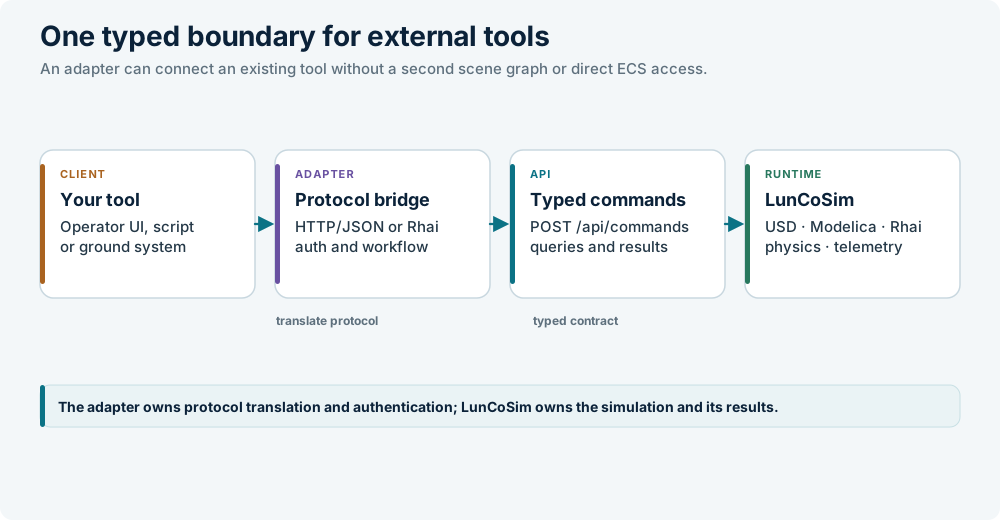
The adapter owns protocol translation, authentication policy, and operator workflow. LunCoSim owns the scene, simulation state, authority, and typed results.
What is available
| Need | Surface |
|---|---|
| Discover entities and ports | ListEntities, ListPorts |
| Claim an endpoint | ClaimControl |
| Write live inputs | SetPorts, SetPortsBatch |
| Release an input or claim | ReleasePort, ReleaseControl, ReleaseControlClaim |
| Read current values | ReadPorts, ReadPortsBatch, ReadActuatorStatus |
| Read telemetry | ListTelemetryChannels, QueryTelemetryHistory, ExportTelemetryRecording |
| Check health | GET /api/ready, GET /api/diagnostics |
| Inspect coupling | CosimStatus, GetBrokenConnections, CausalTrace |
| Capture admitted inputs | StartSessionInputCapture, StopSessionInputCapture, ExportSessionInputCapture |
Not shipped:
- YAMCS, Open MCT, or Grafana adapters.
- CCSDS or XTCE translation.
- A ROS 2 bridge (issue #57).
- Whole-session deterministic replay.
Use the absence of an adapter as an adapter task, not as a missing runtime control surface.
Start with readiness
Launch with an explicit, free API port and keep the API on loopback:
Do not expose the command endpoint to an untrusted network. It executes powerful authoring and control commands and has no general-purpose remote authentication layer.
Wait until the scene is admitted:
Proceed only when ready is true, world_hold is false, and pending_count is
zero. A faulted world is not a slow world; read /api/diagnostics and the
readiness detail instead of retrying commands.
A minimal operator adapter
The following Python example shows the lifecycle. It assumes the endpoint is a
rover and that its declared input names are throttle, steer, and brake.
import json
import time
import urllib.request

PORT = 4101
BASE = f"http://127.0.0.1:{PORT}"
PRODUCER = 4812  # stable for this adapter session; nonzero


def post(command, params=None):
    body = json.dumps({
        "type": "ExecuteCommand",
        "command": command,
        "params": params or {},
    }).encode()
    request = urllib.request.Request(
        f"{BASE}/api/commands",
        data=body,
        headers={"Content-Type": "application/json"},
    )
    with urllib.request.urlopen(request, timeout=10) as response:
        payload = json.load(response)
    if "error" in payload:
        raise RuntimeError(payload["error"])
    return payload["data"]


def find_endpoint(name):
    for entity in post("ListEntities")["entities"]:
        if entity["name"] == name:
            return entity["api_id"]
    raise LookupError(f"no entity named {name}")


endpoint = find_endpoint("Rover")
post("ClaimControl", {"target": endpoint})

try:
    for _ in range(100):
        post("SetPorts", {
            "target": endpoint,
            "writes": [["throttle", 0.2], ["steer", 0.0], ["brake", 0.0]],
            "seq": 0,
            "tick": 0,
            "producer_id": PRODUCER,
        })
        time.sleep(0.05)
finally:
    # Release the hold, then relinquish the endpoint.
    post("ReleaseControl", {
        "target": endpoint,
        "seq": 0,
        "tick": 0,
        "producer_id": PRODUCER,
    })
    post("ReleaseControlClaim", {"target": endpoint})
Replace the input names with the names returned by ListPorts. A write to a
port that the endpoint does not declare is rejected; it is not silently mapped
to a default.
Authority rules
ClaimControlclaims a stable endpoint for the originating session.AcquireControlis the UI-oriented variant that also binds the local camera.- Use
ReleaseControlClaimon disconnect. Do not rely on timeout cleanup. SetPortsis a live input hold.ReleaseControlandReleasePortreturn the input to its authored wiring; they do not write a stop value. If the safe state requires a specific setpoint, write it explicitly before releasing.- Keep one stable, nonzero
producer_idper operator or adapter session. The ID records provenance; it is not an authorization credential. - A claim is exclusive per endpoint. A successful
ClaimControlreleases the previous owner's claim when RBAC and claim policy allow the takeover; do not write through another session's claim without claiming first. SetPortsBatchis atomic on an authoritative host or local embodiment. Shared clients and authenticated network sessions should use single-targetSetPorts,ReleasePort, andReleaseControl.- A rejected command is terminal. Read the error and fix the target, port, or value; do not retry the same request blindly.
Read telemetry
Discover the retained channels first:
channels = post("ListTelemetryChannels")["channels"]
key = channels[0]["key"]

history = post("QueryTelemetryHistory", {
    "key": key,
    "limit": 200,
})
Each sample has a simulation time t and a value v; the response also carries
epoch_jd when a mission epoch is available. A missing value is a hole, not a
zero.
For a recording that can be compared with an experiment or external tool:
The recording has a union time grid and null for channels that did not report
at a given time. It deliberately does not interpolate.
For the current wiring boundary, use ListPorts and then ReadPorts or
ReadPortsBatch. ReadPortsBatch returns one shared sim_tick, so values from
different endpoints can be compared at the same simulation moment. Use
ReadActuatorStatus when the question is whether a commanded actuator has
settled within a tolerance.
Audit and replay
StartSessionInputCapture records a bounded slice of admitted session inputs.
StopSessionInputCapture refuses while an admitted input is still waiting for
its fixed-tick commit. On a native host, ExportSessionInputCapture writes a
durable .lcsin archive; ReadSessionInputArchiveExport reports its status.
That archive is an input record, not a complete replay package. It does not
contain a baseline manifest or a playback consumer, and not every command is in
the input slice. CausalTrace ties an admitted input to its producer, tick, and
sequence, which is useful evidence for an operator action.
Do not claim bit-reproducible mission replay from this build. Deterministic replay is a separate engineering track.
ROS 2 and other protocols
There is no shipped ROS 2 bridge. Keep ROS 2 outside the simulator and translate
its command and telemetry topics into ClaimControl, SetPorts, and the
telemetry queries above. The same pattern applies to YAMCS, Open MCT, Grafana,
or a custom ground tool.
The adapter should:
- Wait for readiness.
- Discover the exact entity and port names.
- Claim the endpoint before writing.
- Send finite values at a controlled cadence.
- Read telemetry or ports for feedback.
- Release the hold and claim on shutdown.
- Expose a clear failure when the API rejects an input.
Checklist
- [ ] The API is bound to a loopback or otherwise private interface.
- [ ] The scene is ready before the first write.
- [ ] The adapter uses stable entity identities, not display names.
- [ ] The adapter knows the declared port names and directions.
- [ ] One operator owns the endpoint claim.
- [ ] The safe condition is written before releasing an input, when required.
- [ ] The adapter releases its claim on every exit path.
- [ ] Rejections are visible to the operator, not retried silently.
- [ ] Telemetry uses a single tick for comparisons.
- [ ] The test includes a negative case and a real verdict.
Related
- Use the HTTP API — request envelope and schema discovery
- Telemetry — live values, history, and graphs
- Integrate your stack — supported boundaries and limitations
- Validation — evidence and accuracy claims