Cosimulation
Cosimulation is the contract between a Modelica model and the rest of the world. The model advances in its own solver; physics advances in Avian; the master clock decides when the two exchange values. Neither side reaches into the other's state.
LunCoSim implements an FMI-CS-shaped master algorithm. It is not a claim that every participant is an FMI implementation. The native Modelica worker and the FMI 3 Co-Simulation backend share the same master invariants.
The master loop
At every fixed step:
- The master clock reaches a communication point.
- Each due participant receives an input snapshot.
- The participant advances by one communication step.
- The master waits for every due participant to return.
- Validated outputs are published with zero-order hold.
- Connections propagate the new values.
- Physics and rendering observe the result.
The loop is a data-plane system. It runs directly in FixedUpdate; it is not
driven through the typed command bus. A command per tick would put a request
id, a dispatch, and a result record in the hot loop for no benefit.
Commands own the control plane: load a scene, compile a model, start or pause a run, change time warp. They start and configure the loop; they do not advance it.
Communication points and hold
A communication point is the only time at which values cross the boundary. Between points, the last validated outputs are held. This is the zero-order hold that makes a coupled step deterministic: every consumer sees the same value for the whole interval, regardless of when it reads.
The default running communication interval is one master physics tick. Longer integer tick multiples are explicit multirate settings. Each worker request admits its ordered input vector atomically, and the shared clock waits for the complete validated response.
A participant that misses its step budget does not silently return a stale value. The step fails visibly, the coupled step faults, and the simulation holds.
Participants and ports
A participant is a SimComponent with named inputs and outputs. Its interface
is published from the model's declaration, not from its solution:
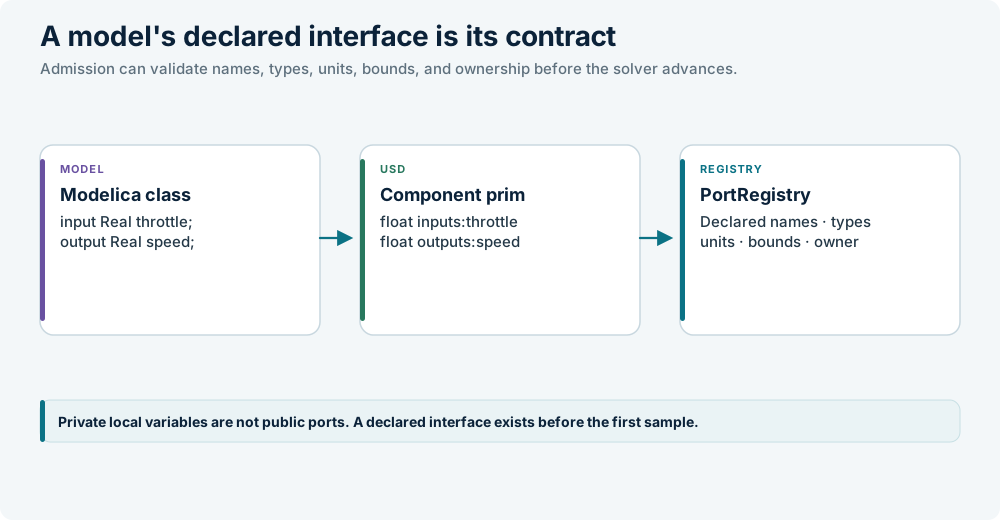
This ordering matters. A model that has not produced a sample yet still has an interface. Admission can check the wire, the units, and the initial inputs before the solver has run.
A model output becomes externally connectable only when the component prim
declares the matching outputs:<name> property. The runtime does not expose
private local variables as public ports.
Initial admission
Initialization is not "step from zero and hope." The owner separates declaration, numerical admission, and running exchange:
- Source interfaces and native physical definitions become available.
- Acyclic participants initialize from finite producer samples.
- Participants with complete inputs prepare independently.
- Coupled participants are captured into a composite initialization problem.
- The composite is compiled and solved at one physical coordinate.
- Members are released together only after their observations agree within solver tolerance.
The synth.coupled-initialization hook emits the composite. Rust supplies the
member facts, classes, bindings, and probes; Rhai emits the nested array
literals in their checked order. Participant parameter values travel separately
as qualified Initialize.parameter_overrides names such as p0.k or
p0.gains[2].
A missing required free coordinate is an error, including an explicitly empty supplied inventory. Failed certification reports a terminal runtime fault and holds the affected participants. A changed source or wire cannot release an old certificate.
This follows FMI 3.0's separation of Initialization Mode and running communication: initialization loops are solved at one physical coordinate before participants advance.
Modelica output ownership
Modelica publishes outputs through its worker response path. The response bridge validates the session, step identity, and communication endpoint before taking the in-flight transaction. Session IDs fence stale results: when a compile or parameter update bumps the session, an in-flight step for the old session is discarded.
The worker reuses immutable compiled DAE artifacts for the same exact target, document URI, assembled source bytes, and source-root revision. Parameter bindings, solver instances, live state, and telemetry remain per entity.
A live solver step failure keeps the solver error and lists the Modelica values that were not produced by the failed step. The list includes each value's last accepted sample and the sample and communication-target times. Names are sorted for stable diagnostics.
Backend registry
Backends self-register at application boot. Each domain crate installs a Bevy
plugin that inserts itself into BackendRegistry. Dropping a crate removes its
backend. A scenario that references a missing backend fails gracefully at load.
Current backends include:
| Backend | Source | Notes |
|---|---|---|
| Modelica | .mo |
Rumoca worker |
| Rhai | .rhai |
Scripted participant |
| Python | .py |
Optional feature |
| FMI 3 CS | .fmu |
Native import, scalar Float64 profile |
| Avian | USD physics | Typed-port participant |
The FMI adapter uses the existing port and connection boundary. It loads and
validates modelDescription.xml, preserves value references and scalar
engineering contracts, and runs the FMI 3 Co-Simulation lifecycle on its native
worker.
The FMI boundary
The native profile supports scalar Float64 ports. Unit and range projection
are implemented, and the shared connection fabric compiles compatible unit
conversions. The importer declines Event Mode and early return; FMUs handle
their internal events. lastSuccessfulTime must match the requested
communication point within the timestamp tolerance.
FMI permits lastSuccessfulTime to deviate from the requested endpoint even
when earlyReturn is false. The owner faults such a response because the
current master cannot synchronize all participants at the reported time.
Supporting intermediate communication points would require rescheduling the
complete due participant set.
FMI Model Exchange requires a separate solver integration and is not admitted as an FMI-CS participant. Other types, arrays, Scheduled Execution clocks, and externally hosted FMUs are rejected with owner diagnostics.
This is an FMI-CS-shaped master, not a broad conformance claim. FMU-to-FMU unit conversion, implicit coupling, and full FMI conformance require separate qualification.
Pause, time warp, and health
Pausing stops the master clock without tearing down participants. A paused model retains its state and its last outputs. Resuming continues from the same communication point.
Time warp changes how fast wall-clock time advances relative to simulation time. It does not change the communication contract: the master still waits for every due participant at each point.
Modelica execution publishes a scene-scoped ModelicaHealthSnapshot from the
admitted step counters. Its one-second native wall-clock window reports
completed-step FPS and worker service time through the shared engine-health
exposure. This diagnostic math does not change simulation scheduling.
Worked example
A rover has a Modelica drivetrain, an Avian chassis, and a Rhai mission:
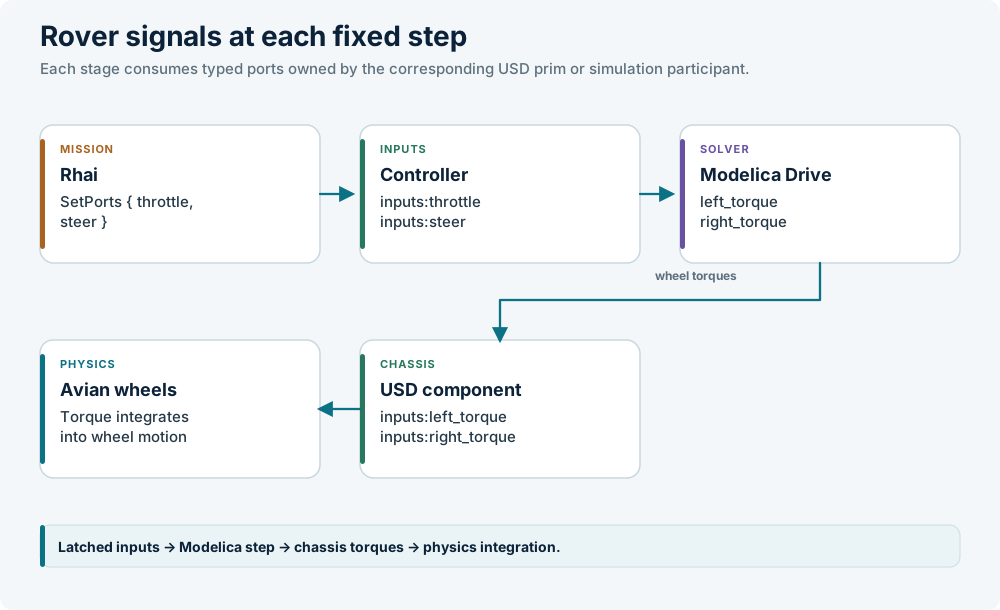
At each fixed step:
- The mission's latest command is already latched in the port registry.
- The controller receives
throttleandsteer. - The solver advances and returns the two torques.
- The torques propagate to the chassis inputs.
- Avian applies them to the wheels.
- The next step samples the new chassis state.
The mission does not step the controller. The controller does not read the scene. The chassis does not know which language produced the torque.
Rules of thumb
- Treat the fixed step as the only exchange point.
- Declare the interface before relying on a sample.
- Expect a missing initial input to hold admission, not to become zero.
- Keep continuous behavior in Modelica; keep discrete decisions in Rhai.
- Use multirate only when a participant genuinely needs a slower clock.
- Inspect
CausalTracewhen a value does not arrive where the wire says it should. - Do not claim FMI conformance beyond the tested scalar profile.
Continue with Lunica, the workbench for authoring and running these models.