How it fits together
LunCoSim separates what the system is from how it behaves and what the operation does. Each layer has a standard format and a clear owner. The runtime composes those layers into one live world and gives every participant the same clock, identity, and command surface.
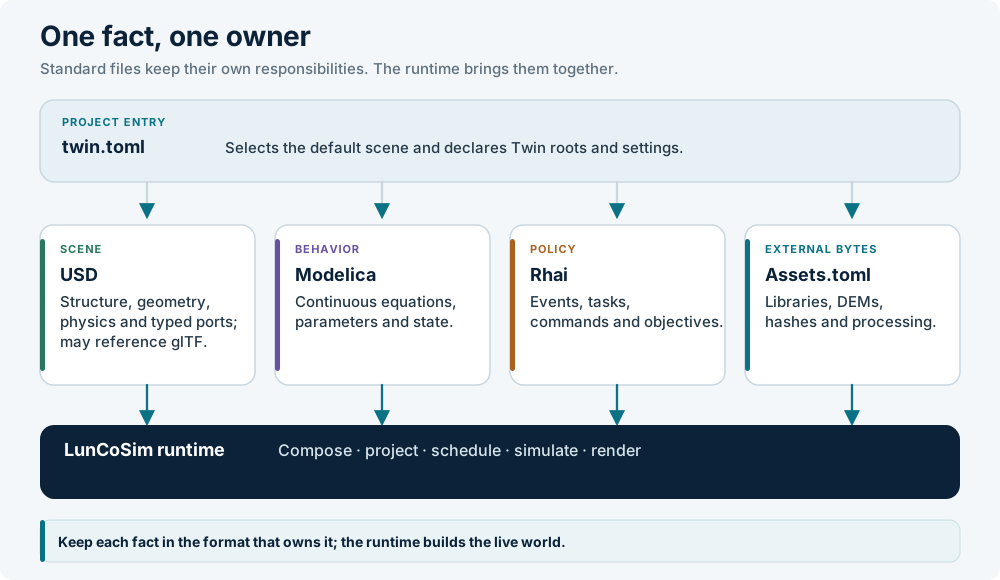
The layers
| Layer | Owns | Does not own |
|---|---|---|
twin.toml |
Project identity, entry scene, search roots, settings | Physical equations |
| USD | Parts, transforms, variants, materials, physics schemas, typed ports, connections | Modelica state integration |
| Modelica | Continuous equations, energy and state balance, solved outputs | Scene traversal or mission sequencing |
| Rhai | Events, commands, sequencing, authored test verdicts | Continuous dynamics |
Assets.toml |
Declarations for external bytes: libraries, rasters, models, fonts | Scene structure or runtime state |
| Rust / Avian | Generic projection, physics, scheduling, and engine mechanics | A particular rover, mission, or lesson |
The important rule is one fact, one owner. A wheel's position belongs in
USD. A motor's torque curve belongs in Modelica. A waypoint mission belongs in
Rhai. A downloaded terrain DEM belongs in Assets.toml and the asset cache.
Runtime flow
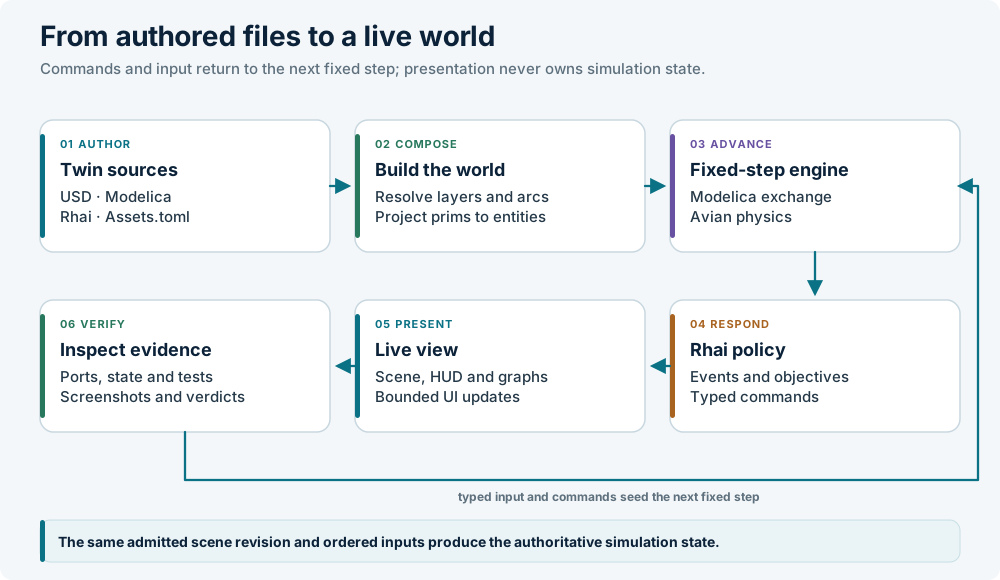
The sequence is easier to understand as a series of boundaries than as a pipeline:
- The Twin opens.
twin.tomlselects the default USD scene and the Modelica and SysML source roots. - USD composition resolves sublayers, references, payloads, and variants into one composed stage.
- The runtime projects the composed stage into the live entity world: scene hierarchy, transforms, physics bodies, colliders, lights, cameras, and program attachments.
- Modelica participants are admitted. The fixed master clock advances them;
outputs cross
SimConnections at declared communication points. - Physics applies forces and integrates the rigid bodies. Rhai scenarios receive events and issue typed commands through the same command and query API as the UI and HTTP API.
- The UI renders the current state. The UI does not mutate domain state directly; it sends commands to the owning layer.
A composed USD stage by itself is inert. It does not launch Modelica, run Rhai, apply physics, or render. The runtime is what projects the authored documents into a live world.
A rover, layer by layer
A single vehicle demonstrates the division better than an abstract diagram. Consider a rover with a chassis, six wheels, a drive controller, and a waypoint mission.
| Question | File | What it contains |
|---|---|---|
| Where is the chassis, where are the wheels, how do they attach? | USD | Xform hierarchy, references, UsdPhysics bodies and joints |
| What is the controller law? | Modelica | .mo equations for drive, steering, motor, or thermal behavior |
| What should the mission do? | Rhai | task, mission, on_event, waypoints, commands, verdicts |
| Where does the terrain DEM come from? | Assets.toml |
URL, dest, optional sha256 and processing recipe |
| Which scene opens? | twin.toml |
[usd] default_scene |
A complete drive loop can look like this:
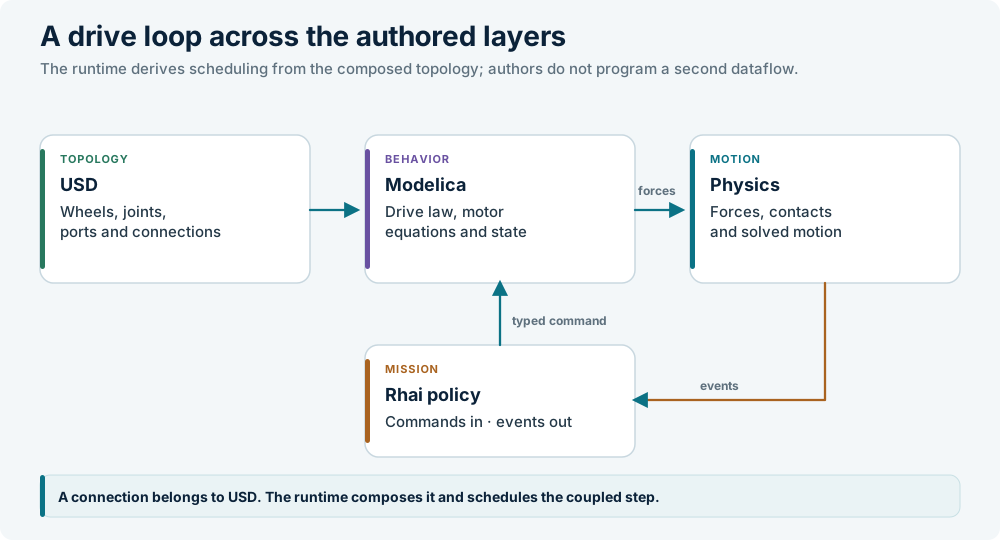
The arrows are not a dataflow that the author programs. They are the consequence of the authored topology. The wheel joint is a USD fact. The motor equation is a Modelica fact. The connection is a USD fact. The runtime derives the scheduling order from the composed graph.
Why the boundaries matter
The boundaries are not bureaucratic. Each one prevents a class of defect.
A single clock. Modelica participants, physics, and Rhai tasks advance on the same simulation timeline. If a script kept its own timer, two parts of the mission would disagree about when "ten seconds" had passed.
A single identity. A prim path, an entity id, and a port owner are related but not interchangeable. The runtime keeps the mapping explicit so a command cannot accidentally target a different rover after a scene reload.
A single authority. Selection, camera control, and input authority are separate. A script that holds a vehicle and a user who clicks Take control are resolved by the same authority rules, not by whichever system wrote last.
A single evidence trail. A scene test runs the authored observer against the production runtime. A parse check runs the same loaders without a window. A live lint sees the composed stage. Each layer reports what it can see and does not pretend to see more.
What stays out of each layer
- Do not put mission decisions or timers in Modelica.
- Do not integrate physics or reimplement a controller in Rhai.
- Do not encode equations in USD attributes.
- Do not add a Rust special case for a specific rover, lesson, or asset.
- Do not hand-edit generated or cached assets; author the source and let the owning pipeline produce the result.
- Do not duplicate a route, a limit, or a tuning constant in a lesson when the value is already authored in USD or Modelica.
A worked boundary decision
Suppose a rover tips over on a slope. There are several tempting places to "fix" the behavior:
- Lower the center of mass in the USD asset. This is a physical change and belongs in USD if the design is wrong.
- Change the suspension spring in the USD suspension schema or the joint drive. This is also a physical change.
- Reduce the speed in the Rhai mission. This is a policy change and belongs in Rhai if the mission should approach the slope more slowly.
- Loosen the test's tilt limit. This changes the evidence, not the system. It is appropriate only when the original limit was wrong and the new limit is justified.
The correct fix depends on the question being asked. The layer boundaries do not choose the answer; they make it clear which answer is being changed.